We Asked an AI for a Brain Faithful to Reality and It Brought Us a Volunteer's From 1998
While redesigning the vidtreo.com home, an ASCII brain led us by chance to Colin 27 and its volunteer. That section announces VIDTREO Intelligence, now in final testing.
TL;DR
- Section 03 of the new vidtreo.com home is the announcement of our new product, VIDTREO Intelligence, which is in its final testing stages.
- That section carries a brain drawn in characters. We wanted it to look real, gave Claude a one-line instruction and, by coincidence, ended up with one of the most used brains in the history of neuroimaging.
- That brain is called Colin 27. It comes from a single volunteer scanned 27 times in the 1990s, and this is his story.
An announcement, and a coincidence
The new vidtreo.com home is a sequence that moves with your scroll. Four objects made of 3D ASCII characters assemble and come apart as you go down: a camera lens (VIDTREO Recorder), a microphone (VIDTREO AI), a brain and a human face.
The brain lives in section 03, “Understand · VIDTREO Intelligence”, labeled “Coming soon”. That section is the announcement of our new product. VIDTREO Intelligence is in its final testing stages.
The idea is simple. You describe what matters to you: score an interview answer, detect buying intent, flag a compliance issue. Intelligence turns each video into structured results, and every claim links to the moment in the video that proves it.
A product that understands video needed a brain. We did not plan for that brain to have a story of its own.
A brain that did not look like a brain
The first version was invented. Two hemispheres with folds generated from mathematical noise and neurons floating around them. The neurons looked exaggerated, so we swapped them for subtle sparks.
It improved, but it still did not look real. It had plausible folds, not anyone’s folds. Anyone who has seen an MRI could tell.
A one-line instruction
We had already solved the same problem for the human face: an open mesh with a clear license instead of an invented shape. From Claude Code, we told Claude to do the same for the brain. The sentence, in Spanish:
“el modelo del cerebro también tiene que ser fiel a uno real, usa la misma estrategia que usaste para el rostro humano”
In English: “the brain model also has to be faithful to a real one, use the same strategy you used for the human face.” Christian Segovia, to Claude.
That sentence says nothing about licenses, neuroimaging or the MNI. Claude found all three on its own, and we did not expect it.
The search
A commercial site cannot use just any mesh. Claude looked for open brains and reviewed NIH 3D, Brainder and FreeSurfer’s fsaverage surfaces. It discarded FreeSurfer because its license is ambiguous for commercial use.
It chose the Colin 27 Average Brain from the Montreal Neurological Institute (MNI), McGill. Its license grants permission to use, copy, modify and distribute the material for any purpose, as long as the copyright notice stays in all copies. It comes with no warranty. We keep that condition, and the full notice appears at the bottom of this post.
Who Colin 27 is
A single volunteer went into an MRI scanner 27 times at the MNI during the 1990s. The researchers registered the 27 volumes and averaged them. The method was published in 1998 in the Journal of Computer Assisted Tomography: Holmes CJ, Hoge R, Collins L, Woods R, Toga AW and Evans AC, “Enhancement of MR images using registration for signal averaging”. With that many scans averaged, even fine details come out crisp.
McGill’s page names the subject only by initials, “CJH”. The wiki of the MRC Cognition and Brain Sciences Unit in Cambridge identifies the volunteer as Colin Holmes, “one of the MNI lab members”. That is where the name comes from: Colin, 27 scans. We write it with that caution because the MRC CBU wiki is our source for the identification.
Colin 27 became a standard template. According to the MRC CBU wiki, SPM96 used it as its standard template, and McGill’s page lists AFNI, Brainstorm, SPM and FieldTrip among the tools that adopted it. Countless studies have used it.
McGill also reports a request. The Museum of Natural Sciences of the Royal Belgian Institute of Natural Sciences in Brussels opened its permanent “Gallery of Humankind” and asked Dr. Louis Collins whether they could produce a 3D print of the historical Colin27 brain. We know they asked. We do not know more than that, and we will not add anything.
We use the 2008 high-resolution version. The original study dates from 1998.
From MRI to characters
We took the real scan data and turned it into a surface. We sampled that surface into about ten thousand points, and each point keeps the real depth of its fold. That way the gyri catch the light and the sulci fall into shadow, as they do in a real brain.
We draw the actual right hemisphere, not mirrored, so the anatomy stays honest. The whole brain weighs about 85 KB.
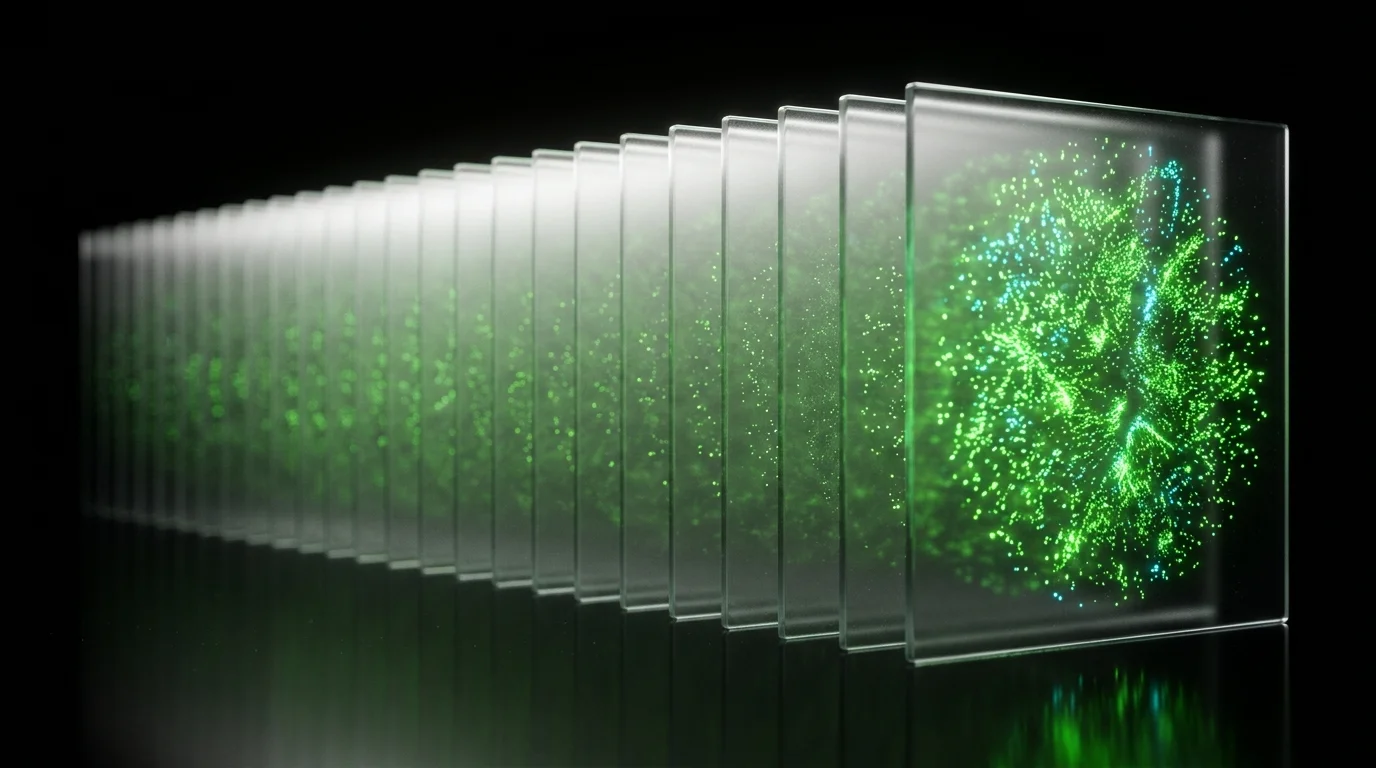
On top we added green sparks that walk along the folds and cyan connections, like roots, that grow and fade. It looks like a brain learning, and that is the idea of the section.
Two heads on one page
In the last step of the home, the face belongs to nobody. It is MakeHuman’s synthetic base mesh, released under CC0 1.0. A person who does not exist shares the page with the brain of someone who does.
The contrast fits what VIDTREO stands for: “Real people. Real recordings.” We let the synthetic face break apart. The brain comes from a real person, so we owe that person credit.
What the AI did
We asked Claude for something simple: be faithful to reality. To do it, Claude solved a design problem (which mesh to use), a legal one (which license works on a commercial site) and a technical one (how to go from an MRI volume to a light drawing). Along the way it surfaced something we had not asked for: the story of a person who lent their brain to science almost thirty years ago.
An AI that only produces illustrations would have given us another pretty, invented brain. An AI that searches, compares and discards connected us with human work that was waiting in a public repository.
We use “new life” as a metaphor about the data. Colin 27 is a template that keeps serving research, and now it is also a drawing made of characters of light. We say nothing about Colin Holmes’ life and attribute no words to him. We talk about the data and about what it let us build.
What comes next: VIDTREO Intelligence
That section of the home is more than a drawing. It is the announcement of VIDTREO Intelligence, our new product, which is in its final testing stages. You describe what matters to you, and Intelligence turns each video into structured results, with every claim linked to the moment in the video that supports it.
Thank you
Thank you to the Montreal Neurological Institute and McGill for publishing Colin 27 under a license that lets others use it. Thank you to Louis Collins and the team at the McConnell Brain Imaging Centre. Above all, thank you to Colin 27: to the person who lay down in a scanner 27 times so that others could study a brain in detail.
See the brain at vidtreo.com. It sits in section 03, on the left, facing the text.
Sources
- Colin 27 Average Brain, 2008 (NIST, MNI)
- Colin 27 at the McGill BIC
- McGill: Colin27 brain makes history and enters a museum in Europe
- MRC CBU: MNI and Talairach
- Holmes et al. 1998, J Comput Assist Tomogr 22(2):324-33
- Aubert-Broche, Evans, Collins 2006, NeuroImage 32(1):138-145
- MakeHuman
MNI license notice: “Colin 27 Average Brain. Copyright © 1993–2009 Louis Collins, McConnell Brain Imaging Centre, Montreal Neurological Institute, McGill University.” The license grants permission to use, copy, modify and distribute the material for any purpose, provided this notice is kept in all copies. It comes without warranty. We keep the credit in the code, in THIRD_PARTY_NOTICES.md and in the README.